

How To Install Cavity Tray Into Existing Wall
We use cookies to ensure we give you the best feel on our website. You tin find out well-nigh our cookies and how to disable cookies in our Privacy Policy. If yous continue to apply this website without disabling cookies, we volition presume you are happy to receive them. Close.

Cavity tray
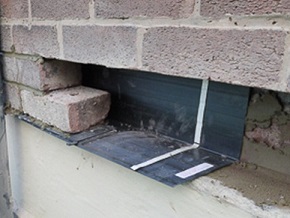
The external masonry walls of modern buildings are mostly cavity walls, that is, they are formed by an inner leafage and an outer leaf of masonry, tied together, but separated by an air gap or 'cavity'.
The cavity prevents moisture transmitting from the outer leafage to the inner leaf. It can also provide a ventilation space, assuasive wet within the wall structure to vent to the outside, and tin can provide a space for the installation of cavity wall insulation.
It is but since the 1920s that external masonry walls in the UK have widely adopted a crenel construction. Before this, they were generally a solid construction.
Cavity trays are included in cavity wall constructions where there are penetrations beyond the cavity, such every bit:
- At an abutment with a roof.
- Above openings such equally doors and windows.
- Where extensions are synthetic against existing walls.
- Above concrete slabs or beams.
- Above airbricks, ducts and pipes.
- At the lesser of a wall, if the crenel does not extend 225 mm below the damp-proof course.
Crenel trays prevent moisture beingness carried to the inner foliage. Very broadly, cavity trays tend to prevent wet that is travelling down from being carried to the inner leaf, whereas damp-proof courses tend to exist used to prevent rise damp.
Approved document C of the Edifice Regulations, Site grooming and resistance to contaminants and moisture, suggests that a crenel tray (or damp-proof course or closer) should be provided to ensure water drains outwards:
- Where the downwards flow will exist interrupted by an obstruction such every bit a lintel.
- Under openings, unless there is a sill and the sill and its joints will form a complete bulwark.
- At abutments between walls and roofs.
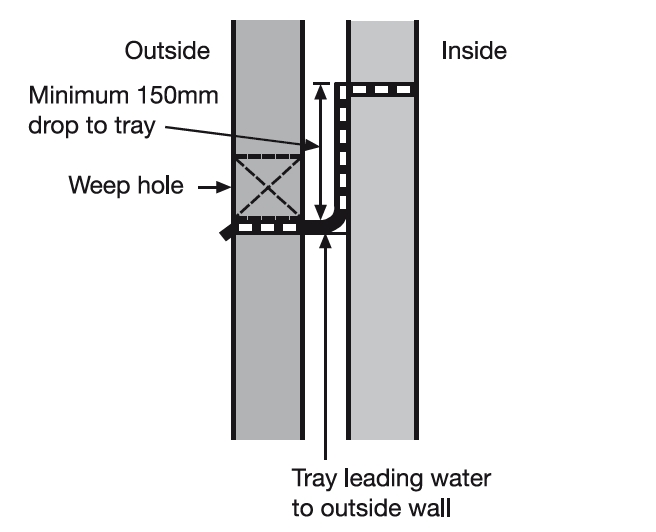 [Epitome source: Approved document C, Site preparation and resistance to contaminants and moisture]
Crenel trays can exist formed using a pliable fabric such as lead, only more unremarkably they are pre-formed, with a wide range of shapes allowing for dissimilar cavity widths, corners, stop ends, steps, lintel shapes, arch shapes and sometimes incorporating external flashing.
Cavity trays must ever exist bedded onto fresh mortar.
Weep holes must exist provided in the external leaf of the wall to allow moisture to drain to the exterior. Cry holes are mostly created by omitting mortar from the vertical joint betwixt bricks, typically at 450-900 mm centres. They may include plastic weep vents which contain a baffle construction to prevent rain from penetrating through the hole and preventing insects from entering the cavity and provide a drip at the forepart lip to assist drainage.
Care must be taken where there is insulation in the cavity to ensure that both the insulation and the crenel tray go along to office correctly. This tin exist particularly problematic where diddled insulation is retrofitted in to existing cavities.
Where it is necessary to insert cavity trays into existing walls, for example, if an extension is existence congenital against an existing wall, this can be done by removing brickwork a department at a time, or by inserting self-supporting crenel trays through slots cut in the wall.
Standards for cavity trays are described in BS 5628 Lawmaking of practise for the utilise of masonry and BS 8215 Code of practice for blueprint and installation of damp-proof courses in masonry construction.
[edit] Related articles on Designing Buildings
- Edifice damp-complimentary cavity walls.
- Cavity wall.
- Cavity wall insulation.
- Cold span
- Condensation.
- Damp.
- Clammy-proof course.
- Defects in brickwork
- Defects in stonework.
- Flashing.
- Insulation.
- Interstitial condensation.
- Lintel.
- Parapet.
- Penetrating clammy.
- Rising clammy.
- The cavity wall existent performance question.
- Types of brick bonding.
- Vapour barrier.
- Wall ties.
- Wall necktie failure.
- Weep hole.

Source: https://www.designingbuildings.co.uk/wiki/Cavity_tray
Posted by: rosexyle1976.blogspot.com
0 Response to "How To Install Cavity Tray Into Existing Wall"
Post a Comment